After Brexit: Which UK-US Food Differences Actually Risk Your Health
A dose-based framework for sorting real additive risks from cosmetic label theater, plus what Brexit has — and hasn't — changed.
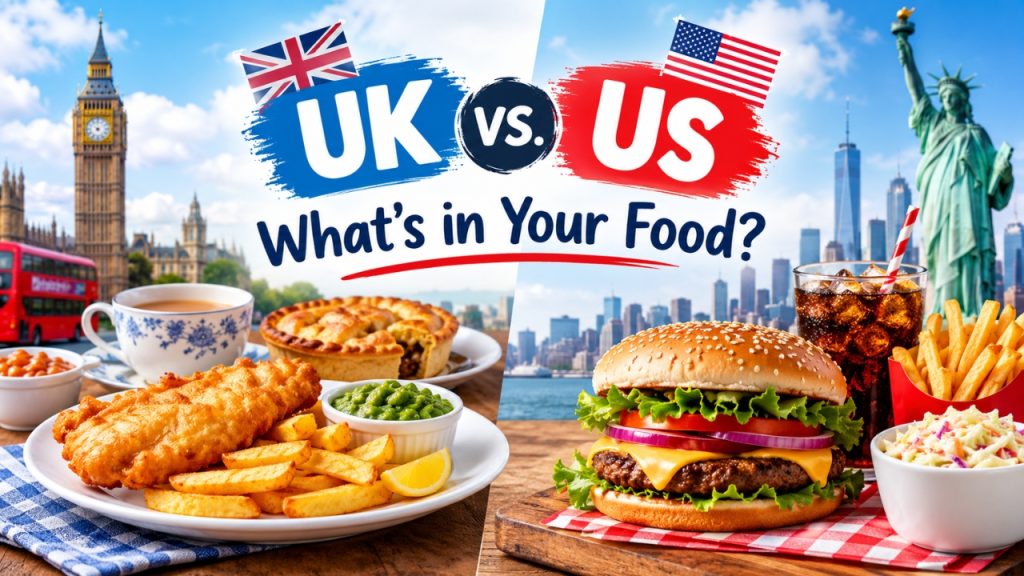
Most of what divides a British and an American grocery shelf is paperwork, not poison. That is the uncomfortable truth hiding behind every viral photo of “banned in the UK” ingredient lists. Imagine two identical boxes of the same cereal brand sitting side by side on a kitchen table — one shipped from a cousin in Ohio, one bought that morning in Manchester. The logos match. The nutrition panels don’t. Before deciding which box is “safer,” it helps to know which differences carry a measurable dose of risk and which are regulatory theater left over from a precautionary principle that Brexit has barely touched.
What Brexit Actually Changed
Here is the part most comparisons skip: Brexit, on its own, has not rewritten Britain’s additive rulebook. When the UK left the EU in 2020, it did not junk the EU’s food-safety architecture — it copied it wholesale into domestic law. The list of colours, preservatives and whitening agents the EU restricts is still, for now, the list the UK restricts. Potassium bromate, azodicarbonamide and the EU-banned synthetic dyes have not been reauthorised for sale in Britain, and chlorine-washed chicken and hormone-raised beef remain outside UK supermarkets, not because the rinse or the hormone itself is the sticking point but because they signal lower farm-hygiene and welfare standards that UK and EU rules were built to keep out. What has changed is optionality. The UK is no longer bound to follow new EU decisions automatically, and future trade deals — particularly any attempt to deepen UK-US agricultural trade — are the real lever that could pull British rules toward American ones. So far, government ministers have treated chlorinated chicken and hormone beef as political red lines rather than negotiate them away. That could shift. The honest forecast is: nothing has diverged yet, but the mechanism for divergence now exists where it didn’t before 2020.
The Dose Is the Argument
Titanium dioxide is the clearest case for why “banned in the EU” doesn’t automatically mean “dangerous at the amount you’ll eat.” A review of titanium dioxide food-additive safety found something regulators rarely admit outright: no one has been able to derive a genuinely safe daily intake for the substance, because batches always contain a nano-sized fraction nobody fully characterized before it entered the food supply. That’s a real gap in the evidence, not proof of harm. Meanwhile, a separate scoping review of occupational titanium dioxide exposure found no association with all-cause mortality across most cohort studies, with only some studies flagging a lung-cancer signal — and that exposure was airborne dust inhaled on factory floors, not the trace amounts swallowed in icing or sweets. The International Agency for Research on Cancer’s “possibly carcinogenic” classification comes from that inhalation data, not from eating. Conflating the two is exactly how a legitimate “we don’t know the safe dose” finding gets mistranslated into “this will give you cancer at breakfast.”
The real dividing line isn’t which country bans an ingredient — it’s whether anyone has ever measured the dose a real person actually eats against the dose that caused harm in a study.
Synthetic dyes sit on firmer ground. A 2025 analysis of synthetic food dyes in children’s diets describes mechanisms — oxidative stress, mitochondrial dysfunction, disrupted dopamine and serotonin metabolism — linked to worsened ADHD symptoms, and argues that current acceptable daily intakes rely on outdated data that ignore cumulative, repeated exposure in children specifically. A narrower review of blue food dyes and ADHD symptoms is more cautious, describing the evidence as limited and the literature thin. Both are honest that this is an emerging, partly observational picture, not a settled verdict — but it is a different category of concern than titanium dioxide, because the exposure (children, repeatedly, over years) and the outcome (behavior, not a rare cancer) are both easier to actually observe.
Scale: What a Real Portion Looks Like
Context helps more than another ingredient list. A typical can-sized portion of cola carries 9.56 g of carbohydrate per 100 g and essentially no other nutrients — 4 mg sodium, 0 g fat, 0 g fiber per USDA cola nutrient data. Compare that to a 100 g raw chicken breast, which brings 22.5 g protein, 330 mg potassium and 65.8 mg of naturally occurring sodium per USDA chicken breast data — a plain reminder that the sodium and sugar differences already well documented between UK and US sodas and cereals dwarf, in daily dietary impact, the trace-level presence of a dye or a whitening agent. Enriched white bread flour, meanwhile, delivers 183 µg folate and 4.41 mg iron per 100 g according to USDA flour nutrient data — nutrients that matter at a scale additives never approach. If you’re triaging where to spend worry, the sugar and sodium load of an everyday diet is the bigger lever by orders of magnitude.
Who None of This Applies To
If you rarely eat packaged, processed, or artificially colored food — cooking mostly from whole ingredients — almost none of this debate touches your actual exposure. The same goes for American shoppers who already buy organic-labeled or European-imported brands, many of which voluntarily avoid titanium dioxide and synthetic dyes regardless of what US federal law permits. And it’s worth remembering the comparison runs both ways: several traditional European foods, including some unpasteurized cheeses, are restricted in the US for reasons that have nothing to do with UK or EU additive philosophy — a reminder that stricter rules don’t always point in the same direction.
The Short List That Actually Matters
If you want a genuine priority order rather than a wall of banned chemicals: put synthetic dyes at the top if you’re feeding children regularly, because the behavioral evidence, while still developing, is the most directly observed in humans. Put titanium dioxide second — not because harm is proven, but because no safe dose has ever been established, which is its own kind of red flag. Put potassium bromate and azodicarbonamide lower on your list unless you eat a great deal of commercially baked bread, since exposure per loaf is small. And let go of chlorine-washed chicken entirely as a chemical worry — the rinse itself isn’t the issue; the hygiene standards behind it are a supply-chain question, not a dose question.
Back at that kitchen table, the two cereal boxes still don’t match. But now the question isn’t “which country is safer” — it’s which specific ingredient, in which specific amount, has evidence attached to it. Most of the shelf is theater. A small part of it genuinely isn’t.
Sources
- USDA FoodData Central: Wheat flour, white, bread, enriched
- USDA FoodData Central: Carbonated cola, fast-food
- USDA FoodData Central: Chicken breast, raw
- Critical review of the safety assessment of titanium dioxide additives in food (2018)
- Protecting developing brains: regulating synthetic food dyes in children’s diets (2025)
- A Review of Blue Food Coloring and ADHD Symptoms in Children (2022)
- Health risks of titanium dioxide dust exposure in occupational settings (2023)