11 Best Morning Drinks for Glowing and Clear Skin
Real trial timelines, exact nutrient numbers, and who should skip lemon water, smoothies, or coconut water for medical reasons.
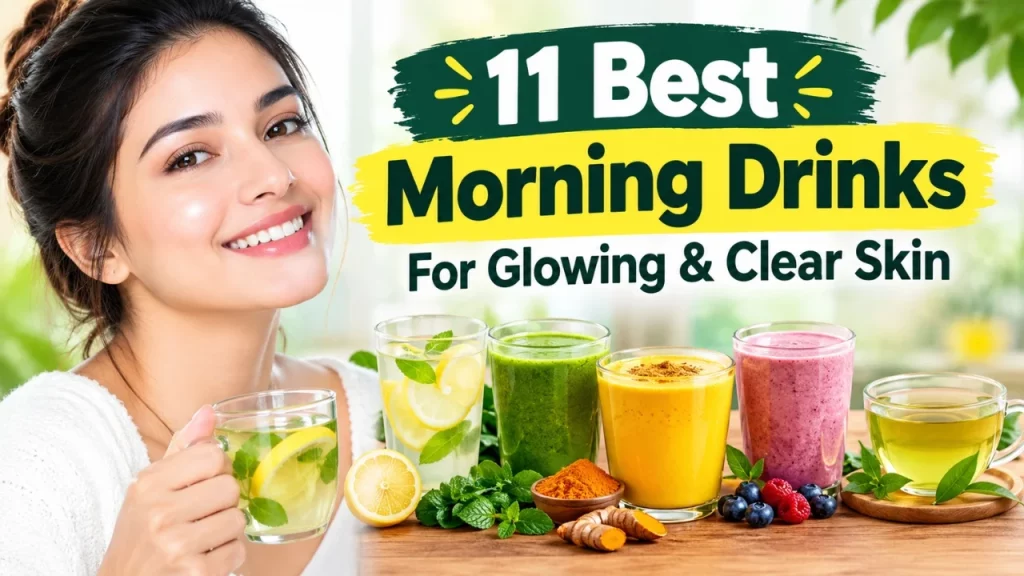
Swap your coffee for lemon water or a collagen shake, the thinking goes, and by the end of the week your skin should look noticeably brighter. It’s a tidy idea, and it’s wrong in almost every specific way. The honest answer involves weeks, not days, a short list of drinks that actually have human skin-outcome data behind them, and a longer list of conditions where a “skin-glow” drink can backfire.
Myth: A Glowing-Skin Drink Works Within Days
Skin is not reactive to diet on a 24-hour cycle. The only way to know how long a drink actually takes to change skin is to look at how long researchers had to wait before they could measure anything. In a 12-week trial of oral collagen peptides, researchers measuring skin hydration and water loss checked participants at 4, 8, and 12 weeks — not at day 3. A separate collagen tripeptide trial followed the same pattern, assessing skin hydration, wrinkling, and elasticity at 6 and 12 weeks. A chocolate flavanol study measuring sun sensitivity and skin hydration took baseline readings and then re-tested at 6, 9, and 12 weeks of daily intake. None of these trials even attempted a one-week checkpoint, because skin cells turn over and remodel on a scale of weeks, and any earlier measurement would have been noise. If a drink claims visible results in under a month, it is not relying on the kind of evidence that exists for skin.
Myth: More Vitamin C in Your Water Means More Glow
Vitamin C gets credit for “glow” because it supports collagen synthesis, but nobody has published a human trial showing that a specific dose of vitamin C from a morning drink produces a visible skin change. What we do have are plain nutrient numbers. A tablespoon-sized splash of lemon juice — about 1 oz or 28 g — contains roughly 11 mg of vitamin C, 1.7 mg of calcium, 29.2 mg of potassium, and 6.24 kcal, according to USDA nutrient data for raw lemon juice. Per 100 g, that scales to 38.7 mg of vitamin C and 103 mg of potassium. Those are real numbers, but there is no study connecting “11 mg here” or “38.7 mg there” to any measurable change in skin brightness, hydration, or clarity. The vitamin C in your lemon water is nutritionally real; the skin benefit attached to it is theoretical.
Myth: Every Antioxidant Drink Has the Same Proof Behind It
Antioxidant is used as if it were one category with one level of evidence, but the quality gap between drinks is enormous. Cocoa flavanols are the rare case with an actual human skin outcome: in a double-blind trial, women who drank high-flavanol chocolate daily for 12 weeks showed a change in minimal erythema dose — the amount of UV needed to redden skin — along with tracked shifts in skin elasticity and hydration. That’s a measured, blinded, placebo-compared result in actual human skin. Green tea catechins and lemon water’s vitamin C, by contrast, are backed mostly by laboratory antioxidant assays and theory about what should happen in skin, not by a trial that measured skin in people who drank them. That doesn’t mean they’re useless — it means the evidence sits in a different, much earlier category, and listicles rarely make that distinction clear.
Myth: Collagen Drinks Rebuild Your Skin Overnight
Even the drinks with the best data have real limits worth knowing before you expect too much. In the 12-week collagen peptide trial, daily doses of 1 g or 5 g increased water content in the stratum corneum and epidermis and reduced transepidermal water loss, and the natural moisturizing factor content in skin rose too — but skin elasticity and skin thickness did not change at all. The collagen tripeptide trial, run over the same 12-week span in women aged 40 to 60, tracked hydration, wrinkling, and elasticity with adjustments for temperature, humidity, and UV exposure, out of caution that weather alone can shift these readings. The honest summary: oral collagen has real, trial-backed support for hydration, not for firmness or wrinkle reversal, and it needs three full months to show even that.
Quick tip: if you want to track whether any morning drink is doing anything, take a plain photo under the same lighting once a week for twelve weeks rather than checking a mirror daily — daily skin variation from sleep, weather, and hormones will hide any real trend long before week four.
Myth: If It’s “Natural,” It’s Safe for Everyone
A drink marketed for skin can still be a poor fit for a specific body. Acidic drinks like lemon water or tomato-based juices can aggravate acid reflux in people with GERD. Dairy- or soy-heavy smoothies are a common trigger for bloating and discomfort in people with IBS. Coconut water’s natural potassium load is already flagged for people with kidney disease who must limit potassium intake, and green tea’s caffeine content is a known issue for anyone with anxiety or caffeine sensitivity. Less discussed is the acne angle: high-sugar juices and fruit-heavy smoothies can spike insulin, a pathway some dermatology research links to acne flares, and protein smoothies built on dairy-based whey carry a similar flag for acne-prone skin. None of this means these drinks are dangerous for everyone — it means “natural” is not the same question as “safe for your condition.”
| Condition | Drink to reconsider | Why |
|---|---|---|
| GERD / acid reflux | Lemon water, tomato juice | Low pH can trigger reflux symptoms |
| IBS | Dairy or soy smoothies | Common trigger for bloating, gas, discomfort |
| Kidney disease | Coconut water | High natural potassium load |
| Anxiety / caffeine sensitivity | Green tea | Caffeine content, even at lower levels than coffee |
| Acne-prone skin | High-sugar juices, dairy-protein smoothies | Possible insulin and dairy-linked acne pathway |
None of this erases the case for a better morning drink. It just means the honest version of that case is slower and more conditional than a headline promising glow by the weekend — three months of consistent intake, a specific condition check against your own health history, and realistic expectations about which outcome, hydration versus wrinkles versus brightness, actually has a trial behind it.
Sources

James Carter
The EverBBQ editorial desk — covering BBQ news, features and everything off the grill.