Adrian Portelli Launches LMCT+ Supermarket With 10% Price-Beat Offer Against Coles and Woolworths
Existing LMCT+ members still face a separate supermarket fee, and the 10% price-beat promise has more fine print than a receipt roll.
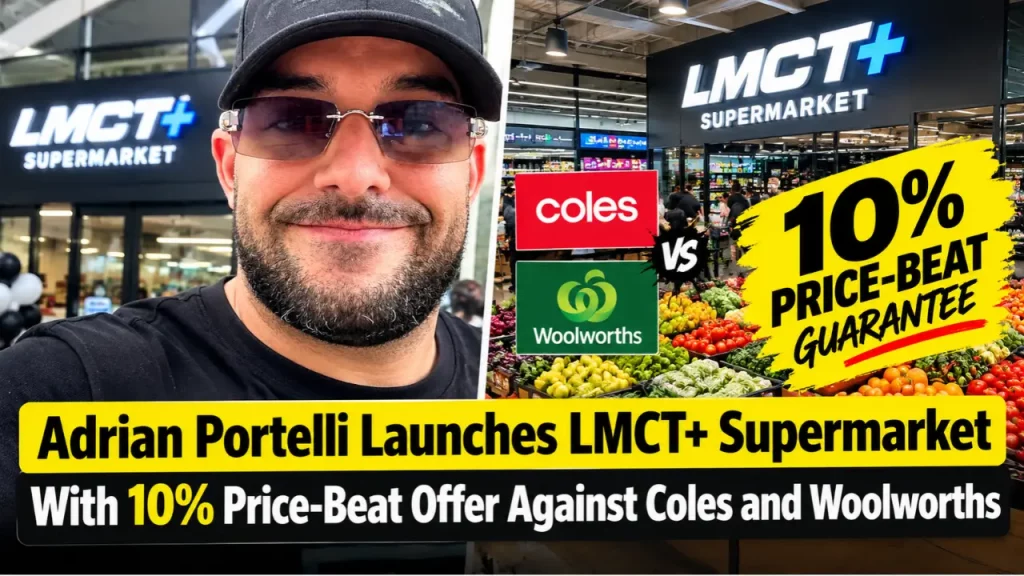
Here is the detail almost nobody checking out LMCT+’s new Deer Park supermarket seems to have confirmed before handing over their card: holding an existing LMCT+ membership, the one built around car raffles, fuel perks and trade-style rewards, does not automatically get you through the supermarket door for free. The grocery arm appears to run as its own paid tier, which means long-time members who assumed their loyalty had already been bought are being asked to buy it again.
That single point matters more than the headline discount, because a price-beat guarantee is only worth anything if you can actually get in the door, actually use it, and actually get your money back if the whole thing turns out to be a dud. This guide walks through exactly that, in order, using what is publicly known about how membership-model retailers structure these offers.
Step 1: Work out whether your existing LMCT+ membership even applies
LMCT+ built its name on competitions, car giveaways and a broader club-style membership tied to Adrian Portelli’s trade and promotions businesses. The supermarket launch is a new, separate retail product sitting under the same brand. Based on how the company has structured its other paid tiers, there is no indication that general LMCT+ membership includes supermarket access as a bundled extra. The sensible assumption, until the company states otherwise in writing, is that supermarket entry requires its own signup and its own fee, regardless of how long you have already been a paying member elsewhere in the ecosystem.
Tip: before paying anything at the door or online, ask the specific question “does my current membership number give me supermarket access, yes or no” and get the answer in writing, not a verbal assurance from floor staff who may not know the backend rules themselves.
Step 2: Understand what the $99 fee actually buys you
The membership mirrors the Costco-style model: an annual fee in exchange for access to the store and its pricing. What that fee does not automatically guarantee is unlimited, uncapped savings. Membership models like this typically make their money on the fee itself plus everyday margin, not purely on the promotional hook, so the headline discount is a drawcard rather than the core business.
Tip: treat the $99 as the price of admission to test the concept for a few months, not as a long-term commitment, until you have personally verified the savings add up to more than the fee.
Step 3: Know the real mechanics of disputing a “non-identical” product
This is the part that will decide whether the price-beat offer works in practice rather than just on paper. A 10% price-beat promise depends entirely on the item at Coles or Woolworths being judged identical to the one on the LMCT+ shelf, same brand, same size, same variant, not promotional or clearance stock. In most retail price-match schemes of this kind, that judgement call sits with the staff member at the register or service desk in the moment, not with a documented, independent appeals panel. If a staff member decides a product is not identical, whether because of pack size, a different flavour line, or a promotional sticker on the competitor’s shelf, the customer’s practical recourse is usually limited to asking for a supervisor or a manager override, not a formal lodged complaint with a guaranteed outcome.
Tip: screenshot or photograph the competitor’s shelf tag, including the barcode and size, before you arrive at LMCT+. A clear photo removes most of the ambiguity staff can hide behind, and it moves the conversation from “I don’t think that’s the same” to a visual comparison they have to engage with.
Step 4: Check for cockroaches in the fine print, caps and limits
Price-beat guarantees in grocery retail almost always carry limits, even when the headline figure sounds unconditional. Common restrictions in schemes of this type include a maximum number of price-beat claims per customer per visit, exclusion of already-discounted or promotional pricing at the rival store, exclusion of items bought in bulk or trade quantities, and a cap on the dollar value of any single price adjustment. Until LMCT+ publishes a detailed, line-by-line policy, shoppers should assume some version of these limits exists rather than assuming the 10% applies without ceiling to every item in a full trolley.
Tip: ask explicitly whether there is a per-item or per-basket cap before you do a big weekly shop expecting the discount to apply evenly across everything.
Step 5: Know your cancellation and refund position before you sign up
Annual membership fees for retail clubs are typically non-refundable once a cooling-off period has passed, and that cooling-off period is often short, sometimes as little as a matter of days under standard consumer protections rather than anything generous offered voluntarily by the retailer. If the supermarket doesn’t deliver savings that beat the $99 outlay within a few months, cancelling does not usually mean getting that fee back pro-rata. Shoppers should check at signup whether cancellation simply stops future renewal or whether any partial refund is offered for the unused portion of the year, because policies vary widely between membership retailers and nothing should be assumed.
Tip: set a calendar reminder near the renewal date rather than relying on the company to remind you, since auto-renewal is standard in subscription retail and silence from the customer is usually read as consent to renew.
Step 6: Separate the man from the marketing when it comes to his wealth
Search interest around Adrian Portelli keeps circling one confused question: is he actually a billionaire, as some headlines claim, or is that an overstatement of an entrepreneur who built his money through competitions, trade promotions and subscription-style membership businesses rather than through a single, verifiable, audited fortune. The honest answer is that “billionaire” is a claim that has circulated in some coverage without the kind of public, audited financial disclosure that would normally back up that specific figure for a private businessman. More measured outlets describe him simply as a businessman or entrepreneur whose wealth has come from building and scaling promotional and membership ventures, which is a very different, far less certain claim than being a confirmed billionaire. Readers should treat the exact net worth figure as unverified and treat the business background, competitions and membership models, as the more solid, checkable part of the story.
Common mistakes shoppers are making
- Assuming an existing LMCT+ membership covers the supermarket without confirming it directly with the company first.
- Walking in without photographic proof of the competitor’s price, then being talked out of a legitimate claim on the spot.
- Doing a full weekly shop expecting the 10% to apply to every single item with no cap, rather than confirming the limits in advance.
- Paying the $99 annual fee without checking the refund and cancellation terms first, then being stuck with a non-refundable fee if the store doesn’t suit them.
- Repeating the “billionaire” figure as settled fact rather than recognising it as a disputed claim sitting alongside more cautious descriptions of Portelli as a businessman.

Tom Fletcher
The latest from the Australian and global BBQ scene — comps, cooks and culture.