Wild’r Launches Ready-to-Eat Tuna Steaks in UK Supermarkets
Ready-to-eat tuna steaks look like the healthier tinned-tuna upgrade, but the protein, sodium, mercury, and cost math tell a messier story.
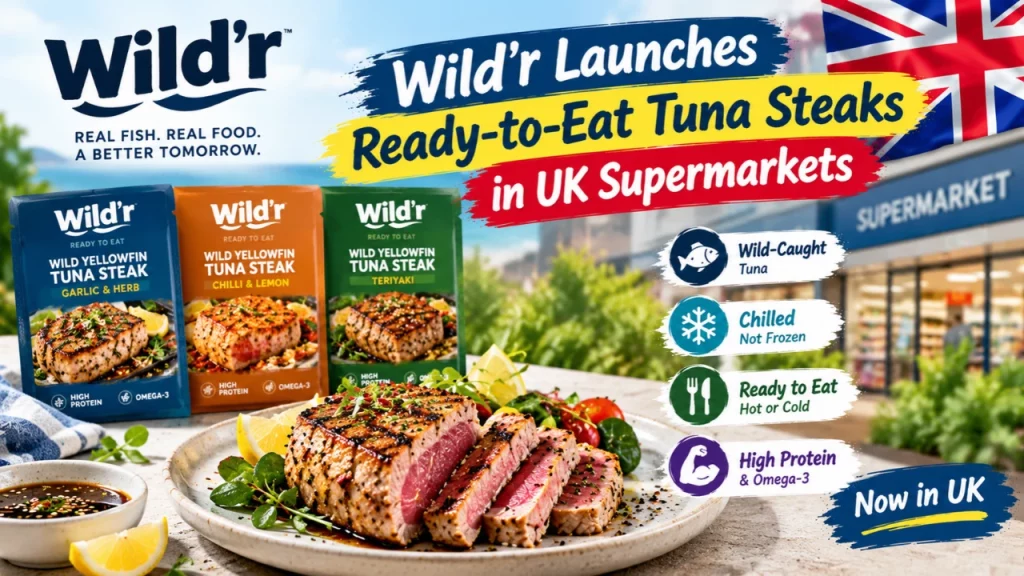
Most people assume a chilled, ready-to-eat tuna steak must be the “upgraded” version of tinned tuna, more protein, less processing, basically fresh fish without the effort. Wild’r’s new grilled tuna steaks just landed in Sainsbury’s, and that assumption is exactly what’s worth testing before you swap your lunchbox staple. The real answer depends on what you’re comparing it to, how much mercury you’re already eating in a week, and whether you’re pregnant, feeding a child, or just trying to hit a protein number without overspending.
Protein and sodium: convenience, not transformation
Tinned tuna in water typically runs around 25g of protein per 100g, with sodium landing somewhere in the low hundreds of milligrams per 100g depending on brand and whether it’s drained. A home-cooked fresh tuna steak, grilled plain with nothing added, tends to sit a little higher on protein, closer to 28-29g per 100g, and dramatically lower on sodium, often under 50mg per 100g, because there’s no brine and no marinade.
A ready-to-eat marinated steak sits between those two, but closer to tinned than most shoppers expect. The marinade that makes it taste like something is also what pushes the sodium back up toward tinned-tuna territory. So the headline protein figure on the pack is real, but it’s not meaningfully higher than what you already get from a 70p tin. What you’re actually paying for is not having to drain a can or stand at a grill. That’s a convenience purchase, not a nutritional upgrade.
The mercury question nobody’s asking at the launch
Tuna’s mercury load depends heavily on species and where it was caught. A study of yellowfin tuna landed on the Ecuadorian coast found that around half of muscle samples tested had cadmium and mercury levels above limits the EU considers safe for consumption. That doesn’t mean every steak on a UK shelf is contaminated, catch location, size of fish, and species all swing the numbers, but it does mean “MSC certified and sustainably caught” tells you nothing about mercury content. Sustainability and heavy-metal safety are separate questions, and no amount of sourcing language on a pack answers the second one.
This is why UK and EU health bodies recommend limiting larger tuna species to no more than one to two portions a week for most adults, and less for people who are pregnant or trying to conceive. A ready-to-eat steak you can finish in one sitting doesn’t change that weekly ceiling, it just makes it easier to blow past it without noticing, because there’s no can to count in the recycling.
Pregnancy and children: this is where it actually matters
The evidence on prenatal mercury exposure is fairly consistent, and worth taking seriously. In a Spanish mother-infant cohort, newborns in the highest quartile of cord blood mercury weighed 143.7g less on average than those in the lowest quartile, and had notably higher odds of being small for gestational age in length. Interestingly, in the same study, mothers who ate canned tuna twice a week or more had babies who weighed more than mothers eating less canned tuna, while eating two or more portions a week of large oily fish was linked to a higher risk of a baby being small for its age. Canned, lower-mercury tuna behaved differently to higher-mercury fish in that data.
A separate multicenter Spanish cohort found that doubling intake of large oily fish during pregnancy was associated with higher cord blood mercury levels. Children aren’t off the hook once they’re born, either. A follow-up study of 9-year-olds in the same region found 13 percent had hair mercury levels above the WHO’s provisional tolerable weekly intake equivalent, measured through childhood. A ready-to-eat steak marketed as a quick protein snack is exactly the kind of food that could quietly add an extra weekly portion for a child who already eats fish fingers and tinned tuna sandwiches. If you’re pregnant, breastfeeding, or feeding a child under 16, this product should count toward your existing weekly tuna limit, not sit outside it because it’s “just a snack.”
Does grilling-then-chilling change the fish?
Grilling at high heat and then chilling isn’t neutral for the fat in fish. A review on fish intake looked at how processing and high-temperature cooking methods can generate oxidation byproducts and compounds like polycyclic aromatic hydrocarbons, noting that the omega-3 fats most susceptible to oxidation are also the ones most affected by smoking or high-heat cooking. The research in that review is mixed and largely observational, it was examining prostate cancer risk specifically, not ready-meal tuna, so don’t read it as a verdict on this product. But it does support a simple point: a steak that’s been grilled, cooled, packed, and stored loses some freshness advantage over fish cooked and eaten within minutes. It’s still a reasonable omega-3 source. It’s just not nutritionally identical to fish straight off your own pan.
The real cost of the protein
Do the arithmetic rather than trusting the protein number on the front of the pack. A typical UK tin of tuna in water, around 70-90p for roughly 110g drained weight, delivers protein at a noticeably lower cost per gram than a premixed, pre-marinated, refrigerated single-serve steak, which carries the extra cost of grilling, chilling, packaging and a shorter shelf life. Chicken breast, bought in bulk, usually beats both on cost per gram of protein by a wide margin. None of that makes the tuna steak a bad product, it just means it’s priced as a convenience snack, not a budget protein source.
Who should skip it
Skip or limit this if you’re pregnant, breastfeeding, feeding a young child, already eating tinned tuna or other fish several times a week, watching your sodium intake, or trying to stretch a protein budget as far as possible. It’s a reasonable pick if you want a mercury-moderate, no-prep lunch occasionally and you’re tracking your weekly tuna total anyway.
The honest takeaway: this product is a convenience win, not a nutrition upgrade, and it still counts against the same weekly tuna limits as the tin in your cupboard.
Do you track how many portions of tuna you actually eat in a week, or does it just blend into “fish, probably fine”?
Sources
- Heavy metals in yellowfin tuna landed on the Ecuadorian coast (2016)
- Fish consumption during pregnancy, prenatal mercury exposure, and birth measures, Spain (2009)
- Mercury exposure among 9-year-old Spanish children (2019)
- Fish intake and risk of prostate cancer, review (2014)
- Prenatal mercury exposure in a multicenter cohort study in Spain (2011)

Tom Fletcher
The latest from the Australian and global BBQ scene — comps, cooks and culture.