How to Make Juice Without a Juicer: 3 Nourishing Homemade Recipes!
Real numbers on how much fiber and vitamin C blending saves versus juicing, and who should skip homemade juice entirely.
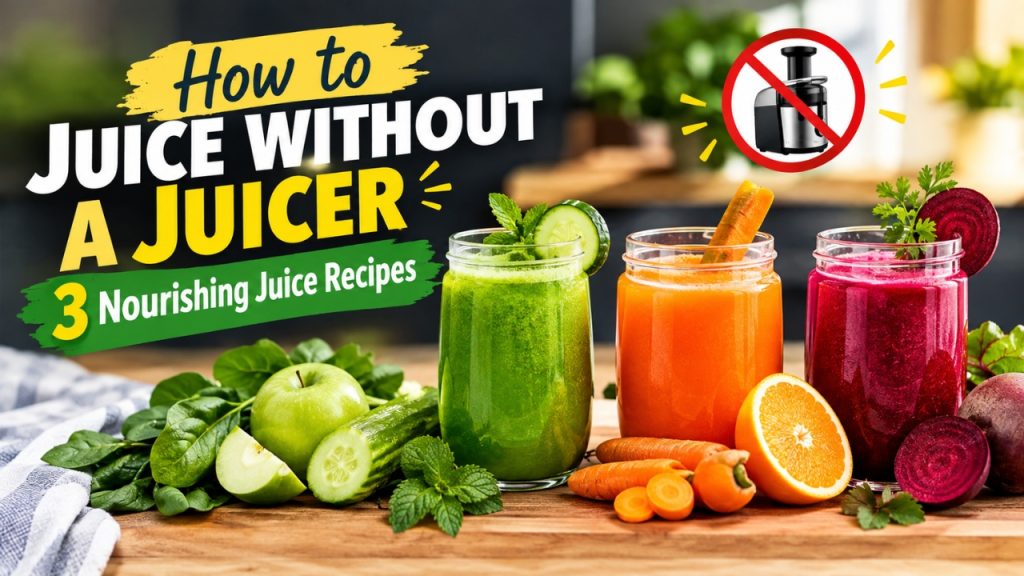
You strain the orange-carrot pulp through a tea towel, catch the last amber drops in a glass, and before you’ve even rinsed the blender jar someone in the kitchen asks the question you don’t actually have an answer for: does straining it undo the point of making it at home, and how long do you have before that glass stops being “fresh” in any way that matters?
1. The blend-and-strain method, in one paragraph
If you don’t own a juicer, a blender plus a fine mesh sieve, nut-milk bag, or doubled cheesecloth gets you juice: chop the produce, blend with a little water, strain out the solids. That basic technique, and the usual trio of green, carrot-orange, and beet combinations, is well covered elsewhere. What isn’t well covered is what actually happens to the nutrients and your blood sugar once you’ve done it, and that’s where the real decisions live.
2. The yield you should actually plan for
A cup of chopped produce never comes back to you as a cup of juice. Leafy greens like spinach or kale are mostly water locked inside fibrous cell walls that a home blender doesn’t rupture as thoroughly as a commercial juicer’s cutting disc does, so a big handful collapses down to a surprisingly thin trickle once strained. Dense produce like carrots and beets gives you more liquid per cup than leafy greens do, but you’re still losing volume to the fiber you strain out and discard. The practical upshot: if a recipe serves two, buy noticeably more raw produce than the recipe photo suggests, especially if greens are the base, or you’ll be stretching the batch with water and diluting everything else along with it.
3. Does keeping the pulp actually change your blood sugar response?
This is the part competing articles mention in passing and never quantify. Several controlled trials have tested exactly this, by adding fiber-rich pomace back into juice and measuring blood glucose afterward.
| Study | What was tested | Result |
|---|---|---|
| orange pomace added to orange juice | 5 g fiber from orange pomace stirred into OJ, vs. plain OJ, vs. whole orange, carbs matched at 19.3 g | Pomace-added juice blunted the glucose spike compared with plain juice, but still didn’t match eating the whole orange |
| enzyme-treated orange pomace in orange juice | 5 g fiber added to OJ in 10 healthy adults | Significant drop in 2-hour glucose area-under-curve versus plain OJ (p=0.02), and lower peak glucose (p<0.05) |
| apple pomace added to apple juice | 5 g fiber added to apple juice, vs. plain apple juice, vs. whole apple, carbs matched at 24 g | Delayed the time it took to hit peak glucose and peak insulin compared with both plain juice and whole fruit |
| acacia gum fiber in orange juice | 20 g or 40 g soluble fiber added to OJ with breakfast, 48 healthy adults | No significant change in overall glucose area-under-curve, though the 20 g dose produced measurably lower glucose at the 30-minute mark; the 40 g dose increased fullness but also bloating and flatulence |
Put together, these small but controlled human trials point the same direction: leaving fiber in your juice, which is exactly what blending and loosely straining does compared with hard juicing, slows down and somewhat flattens the sugar spike, though the effect is modest and doesn’t erase the gap between juice and whole fruit. A straight-through-the-cheesecloth strain removes much of this benefit; a looser strain, or skipping straining altogether and drinking it with pulp suspended in, keeps more of it.
4. What’s actually known about oxidation speed
Readers often ask exactly how many minutes it takes for vitamin C to collapse once you’ve blended it. The honest answer is that the published human trials cited above weren’t designed to measure that, so pinning an exact figure on how much antioxidant content disappears in the first hour after blending isn’t something current research quantifies reliably for a home kitchen glass of juice. What the same body of research does make clear is that the composition of the juice, pulp in or pulp out, matters more for your body’s actual response to it than the clock does. Treat “drink it soon, refrigerate what’s left” as sound general practice, but don’t assume an hour-old glass has become nutritionally worthless; no cited trial supports that specific claim.
5. No blender either? Mash and grate instead
Soft fruit like oranges, melon, or very ripe mango can be mashed by hand with a fork or potato masher against the side of a bowl, then pressed through a sieve with the back of a spoon. Firmer produce like carrots, beets, and apples can be grated on the fine side of a box grater, then squeezed hard in a clean cloth or cheesecloth over a bowl, the same squeezing motion you’d use wringing out a wet towel. It’s slower and the yield is smaller than blending, but it needs nothing electric at all.
6. Who should think twice before drinking this
People managing diabetes are the clearest case. A 2026 study of 86 adults in London comparing postprandial glucose responses to a glucose drink and to orange juice found that habitual diets lower in fiber and several micronutrients tracked with different glycaemic responses across ethnic groups, though the authors describe this as exploratory and cross-sectional, not proof of cause and effect. Combined with the pomace trials above, the practical takeaway is that a glass of mostly-liquid fruit juice, even homemade, delivers a faster sugar load than the same fruit eaten whole, and that matters more for someone managing blood sugar than for someone who isn’t.
People prone to kidney stones should also be cautious with specific recipes, not juice in general. Beet greens, spinach, and kale are all high in oxalates, and juicing concentrates several cups of leafy greens into one glass you drink in a few minutes, delivering far more oxalate at once than you’d get eating the same greens cooked or whole. If stones have been an issue for you, the carrot-orange combination is a safer bet than the green or beet recipes.
7. A realistic way to drink it
Buy more raw produce than the recipe implies, skip the finest strain if your blender and throat can tolerate some texture, and treat the juice as a sugar-containing drink rather than a free pass, particularly if diabetes or kidney stones are part of your history. None of that requires a juicer, a blender, or even electricity, just a clear idea of what’s actually happening between the cutting board and the glass.
Sources

Tom Fletcher
The latest from the Australian and global BBQ scene — comps, cooks and culture.