Coca-Cola Is Introducing a New Drink Flavour That Everyone Will Want to Try
Cherry Lime and Strawberry Float are coming in 2027 — but Coca-Cola's own history says only some new flavors survive past year one.
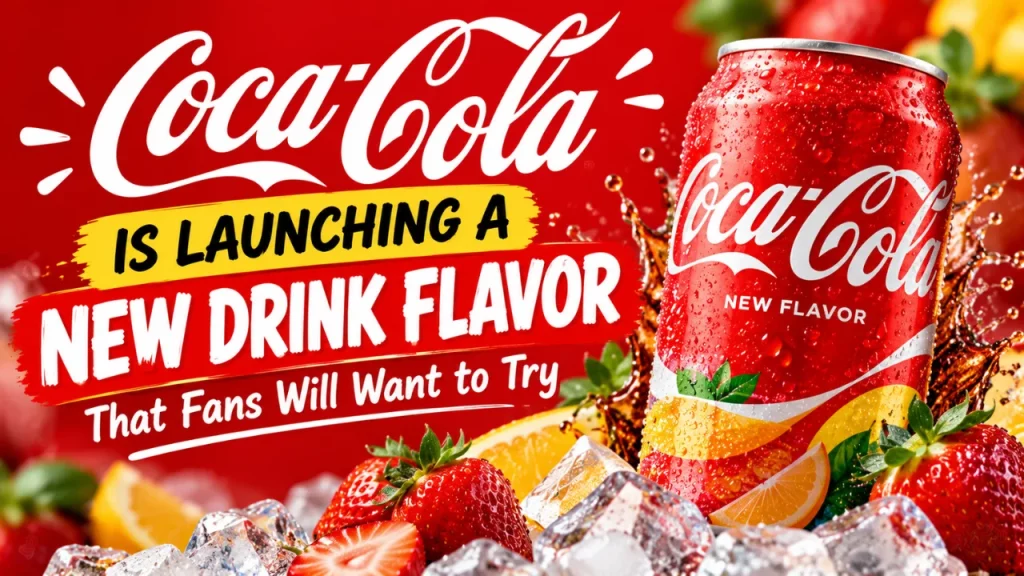
It’s natural to assume that once Coca-Cola announces a new flavor, it’s only a matter of time before it’s sitting on every store shelf in the country. The 2027 lineup — led by two cola flavors, Cherry Lime arriving in February and Strawberry Float landing in summer — complicates that assumption considerably. Some of what Coca-Cola is testing this year will likely become a permanent fixture in the soda aisle. Other parts of the lineup, based on how the company has behaved before, are built to disappear. Here’s what separates the two, and what that means for anyone deciding whether to stock up or just enjoy it while it lasts.
Myth: A National Announcement Means National Shelves
Coca-Cola has a habit of introducing flavors with fanfare, running them for a limited window, and then quietly pulling them. Orange Vanilla Coke launched in 2019 to genuine buzz but was eventually discontinued as a standalone line. Coke Y3000, the AI-themed limited edition, was explicitly sold as a short-run novelty from the start and vanished on schedule. Oreo-flavored Coke, part of the same “Creations” limited-release strategy, followed the identical pattern: big launch, short shelf life, gone before most casual drinkers even tried it. League of Legends Ultimate Coke, tied to a gaming tournament, was never positioned as anything but temporary.
Against that backdrop, Cherry Lime looks more like a candidate for permanence — it’s positioned as a core flavor addition rather than a tie-in or seasonal stunt, closer in spirit to how Cherry Coke or Vanilla Coke became permanent additions decades ago. Strawberry Float, by contrast, carries the hallmarks of a seasonal limited run: a summer launch window, a dessert-inspired flavor pairing, and no indication it’s meant to anchor the lineup year-round. If history holds, expect Cherry Lime to still be around at the end of 2028, and Strawberry Float to be a “remember when” flavor by then.
Myth: Flavor Differences Mean Nutrition Differences
As of now, Coca-Cola has not published sugar, calorie, or caffeine figures for either Cherry Lime or Strawberry Float, so anyone searching for exact per-can numbers won’t find them yet — and that absence is itself worth noting before the marketing push ramps up. Based on how past flavored colas have been formulated, new variants typically track close to original Coke’s sugar content rather than dramatically exceeding or undercutting it, but “typically” isn’t a guarantee, and readers should treat any specific number circulating online before an official nutrition panel drops with skepticism.
What’s not in dispute is the broader health picture around sugar-sweetened sodas generally. National survey data from 2012 found that 26.3% of adults across 18 states consumed regular soda or fruit drinks at least once daily, with the average U.S. adult taking in about 151 kcal per day from sugar-sweetened beverages during 2009–2010. That’s not a judgment on Cherry Lime specifically — it’s context for why any new cola flavor, however appealing, adds to a category already linked to measurable health outcomes.
Myth: Something Sweetened Can’t Really Affect Your Body That Much
Several recent studies suggest otherwise, even if none of them tested Coca-Cola’s new flavors directly. A 2026 analysis of American Indian or Alaska Native high school students found an association between soda or sports drink consumption and lower rates of past-year dentist visits, a combination researchers flagged as concerning given existing barriers to dental care in that population. Separately, research among adults in Barbados, Puerto Rico, Trinidad and Tobago, and the U.S. Virgin Islands found that people without diabetes consumed an average of 7.6 teaspoons of added sugar per day from sugar-sweetened beverages, while those unaware they had diabetes consumed slightly more, at 7.4 teaspoons daily.
A U.S. analysis using NHANES data from 2007–2016 also found that excessive added sugar intake from soda was associated with a 1.5- to 2.0-fold higher likelihood of hyperuricemia in young and middle-aged men, a condition linked to gout. And among SNAP-eligible children, soda consumption in the past month was tied to greater obesity risk, particularly among Hispanic youth, in a 2009–2010 NHANES-based study. None of this means one can of Cherry Lime changes anyone’s health trajectory — but it’s the honest backdrop against which “a flavor everyone will want to try” should be read.
Myth: A Zero Sugar Version Is Automatically Coming
For anyone managing diabetes or simply counting calories, this matters more than the flavor itself. Coca-Cola has not confirmed Zero Sugar formulations of either Cherry Lime or Strawberry Float alongside the original announcement. Given the diabetes-related sugar intake patterns documented in the Eastern Caribbean research above, the absence of a confirmed no-sugar option isn’t a minor footnote — it determines whether these flavors are even an option for a large share of regular soda drinkers until, or unless, Coca-Cola announces otherwise.
Myth: The Prebiotic Fiber Test Is Basically a New National Soda
The prebiotic fiber trial running in New York, New Jersey, and Pennsylvania for Zero Sugar colas is a regional test for a reason: companies trial reformulations in limited markets before committing to national production and marketing spend, using real purchase data rather than surveys to decide whether to scale up. The product reportedly adds 6 grams of prebiotic fiber per can, but none of the health research reviewed here specifically measured how an isolated 6-gram prebiotic fiber dose in a soda affects digestion or gut bacteria in humans — the available evidence instead focuses on the risks of sugar-sweetened beverages broadly, not the benefits of fiber additives layered on top of them. Until independent research or expanded rollout data emerges, it’s reasonable to treat the “gut health” framing as an added feature still being tested, not a settled nutritional upgrade.
Myth: “Rarest Coke Flavor” Searches Are Just Nostalgia
People searching for discontinued Coke flavors are often trying to answer a practical question: is this thing I remember actually gone for good, and is it worth tracking down a last bottle. Given Coca-Cola’s pattern of pulling limited-run flavors like Y3000 and Oreo Creations within a year or two of launch, that instinct isn’t irrational — it’s pattern recognition. If Strawberry Float follows the seasonal-limited playbook, the window to actually try it may be shorter than its summer marketing suggests.
Which part of the 2027 lineup do you think deserves to become permanent — and which one do you expect to vanish by next year?
Sources
- Association Between Soda or Sports Drink Consumption and a Past-Year Dentist Visit (2026)
- Consumption of sugar-sweetened beverages and T2D diabetes in the Eastern Caribbean (2023)
- Age difference in the combined effect of soda drinks consumption and body adiposity on hyperuricaemia in US adults (2021)
- Consumption of sugar-sweetened beverages and obesity in SNAP-eligible children and adolescents (2020)
- Sugar-sweetened beverage consumption among adults — 18 states, 2012 (2014)

Tom Fletcher
The latest from the Australian and global BBQ scene — comps, cooks and culture.