KFC Free 8-Piece Bucket Deal: How to Claim It Before It Ends (Code KFSPEED)!
Typing KFSPEED at checkout may not be enough — here's the account step most people skip, plus the conflicting end dates and who should skip it entirely.
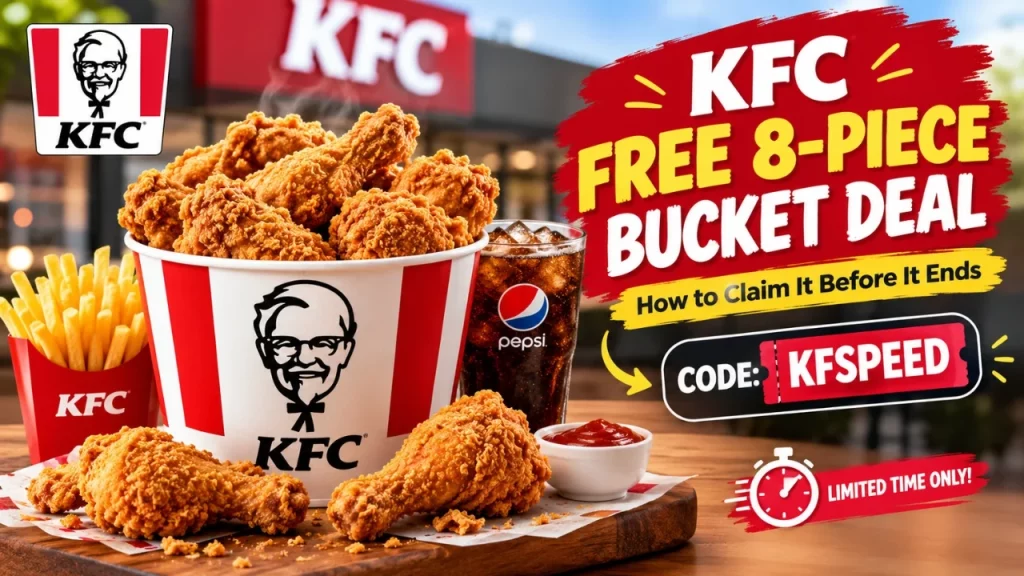
Most people assume this is a simple “type the code, get the bucket” situation — open the app, enter KFSPEED at checkout, done. That assumption is why so many carts are about to fail at the last step. The mechanic behind this promotion is more particular than a typed code, the stated value of the free bucket varies depending on where you read about it, and the end date itself is not as settled as it sounds. Here’s what actually has to happen inside your account, and who should sit this one out.
Do you type the code or clip an offer first?
You almost certainly need to add the offer to your Rewards account before you ever reach checkout, not just type a code at the payment screen. KFC’s promotional codes typically work one of two ways: either they’re a universal string typed into a promo-code field during checkout, or they’re a digital “offer” that has to be loaded onto your account — the same way a coupon has to be clipped before it scans at a grocery register. The phrasing circulating about this deal, which describes redeeming “the offer” prior to checkout rather than entering a code at checkout, points strongly toward the second model. In practice, that means the correct sequence is: open the KFC app or site, log into your Rewards account, locate the offer in the Offers or Rewards tab, tap to add or activate it, and only then build your order. The code KFSPEED may simply be the label used to locate that offer in a search bar or promotions list — not a string you type into a blank field and expect to work on its own.
What happens if the code doesn’t apply at payment?
If the discount fails to appear, the most likely cause is that the offer was never added to the account beforehand — not that your order total is wrong. Most troubleshooting advice for fast-food app deals jumps straight to “check your subtotal, make sure you hit the minimum.” That’s worth checking, but it’s often not the real problem here. An offer that lives in your Rewards tab has to be activated while you’re logged in, and it has to be activated before the order is assembled, not after items are already in the cart. If you build your whole order first and then go hunting for a promo field, you may find there isn’t one — because the system is waiting for you to select the offer, not type it. The fix, if the bucket isn’t discounting at checkout, is to back out of the order entirely, go to the offers section first, confirm the 8-piece bucket offer shows as active or “added,” and only then start a fresh order.
The single most important thing to understand about this deal is that it behaves like a coupon you have to clip, not a code you get to guess — and skipping that clip step is the most common reason people walk away thinking the promotion was fake.
Does guest checkout work for this?
No — if the offer has to be loaded onto a Rewards account before checkout, then ordering as a guest almost certainly won’t trigger it. Guest checkout exists specifically to let people order without logging in, which means there’s no account for an offer to attach to. Anyone who normally skips account creation to save time at the register should expect this deal to be unavailable to them unless they create or log into a Rewards profile first. This is a meaningful gap, because a large share of fast-food app users default to guest mode out of habit, and they’re the group most likely to report that “the code didn’t work” when the real issue is that they were never in a position to redeem an account-based offer in the first place.
How much is the free bucket actually worth?
The honest answer is that the stated dollar value depends entirely on which bucket you choose and which menu price it’s measured against, so a single flat figure should be treated as an estimate rather than a guarantee. Bucket pricing varies by region, by whether tenders or wings are priced differently than classic fried chicken, and by whether a location bundles sides into the base bucket price or charges for them separately. A number presented as the deal’s value is best read as one person’s calculation at one location on one day — useful as a ballpark, not as a receipt you can hold a store to. If getting a specific dollar figure right matters to you, the more reliable move is to price out the same bucket in your own app before redeeming anything, so you know your personal baseline instead of relying on someone else’s local math.
Which end date should you actually trust?
Treat the later date as aspirational and the earlier “last day” framing as the one to plan around, because promotions tied to a marketing partnership typically get pulled the moment the sponsor’s campaign window closes, regardless of what a calendar listing says. When two different end points are floating around for the same offer, the far-off date is usually a placeholder — either an expiration built into the backend system as a default, or a rounded-up estimate — while the near-term “ends soon” language reflects the actual marketing push. Since this deal is tied to a celebrity partnership rather than a standing menu promotion, it’s reasonable to expect it can be switched off quietly once the campaign’s visibility cycle ends, with no obligation to honor a far-future date that was never the operative one. The safe assumption is that the deal could end at essentially any point without much warning.
Who should skip this deal entirely?
Single diners, delivery-only households, and anyone at a location that’s run out of bucket stock are the three groups most likely to find this not worth the effort. A free 8-piece bucket only makes financial sense if you’re also spending close to the required minimum on food you’d buy anyway — for one person, hitting that threshold usually means over-ordering or paying for sides you don’t need, which erases much of the savings. Delivery-only users face an added risk: third-party delivery apps frequently don’t honor loyalty-program offers the same way the KFC app does, since the offer lives in KFC’s own Rewards system rather than the delivery platform’s cart logic. And because the bucket is a physical, limited-stock item rather than a generic menu swap, locations that are low on fried chicken inventory may be unable to fulfill the specific item even after the discount has been successfully applied, leaving you with a confirmed offer and no bucket to show for it.

Tom Fletcher
The latest from the Australian and global BBQ scene — comps, cooks and culture.