Souplantation Returns to Orange County in 2027: Location and Latest News
A six-year ownership chain explains why Fountain Valley is opening in 2027 — and why that timeline is actually a good sign, not a bad one.
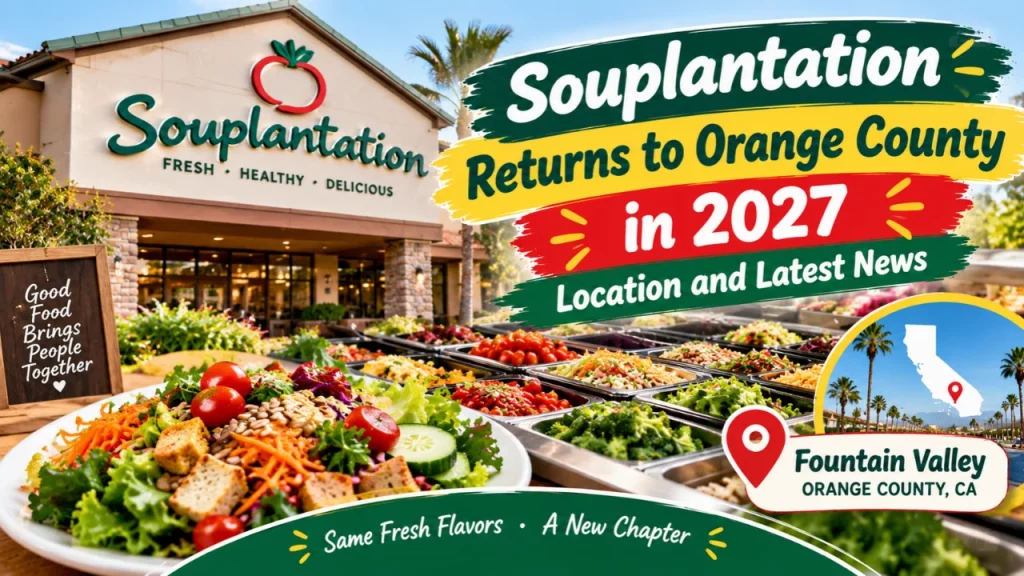
A buffet chain that died in 2020 is coming back in 2027, and the seven-year gap is the entire story. Fountain Valley will get a new Souplantation location in Orange County, but the real question isn’t where or when — it’s whether a brand that collapsed under bankruptcy, sat dormant through a pandemic, and changed hands at least twice can actually survive a second launch. Here’s what the ownership trail and the format’s own history suggest, separated from the wishful thinking.
Myth: The self-serve buffet problem has been fixed
The biggest reason Souplantation (and its sister brand Sweet Tomatoes) shut down for good in 2020 wasn’t just COVID-era lockdowns — it was that the entire business model relied on dozens of strangers reaching into the same bins with the same tongs, scooping from open salad trays and soup wells for hours at a time. That is precisely the kind of close, repeated, hand-to-surface contact that health officials spent 2020 and 2021 telling people to avoid. Buffets didn’t just lose revenue during shutdowns; they lost the psychological comfort that made people willing to eat that way in the first place.
The fact that a 2027 reopening has been announced does not mean that discomfort has been resolved. It means enough time has passed, and enough normal life has resumed, that an operator is betting the stigma has faded rather than disappeared. There is a real difference between those two things. A health scare that is “forgotten” can resurface instantly with the next norovirus outbreak or flu season headline, and self-serve food bars are always the first format blamed. Nothing about the underlying physics of an open buffet line has changed; what’s changed is public patience, and patience is reversible.
Myth: All the old locations are coming back, one by one
Souplantation and Sweet Tomatoes operated around 97 locations across the country before the 2020 closures, with a large share of those concentrated in California. Only one of them — Fountain Valley — has an announced reopening date as of now. There is no confirmed pipeline of the other California sites, and no public list of additional cities under negotiation. Former Souplantation buildings in Southern California have mostly been repurposed, sitting vacant for long stretches before being leased to other restaurant concepts, converted into different businesses entirely, or demolished for redevelopment.
That matters because a true brand revival and a single nostalgia-driven reopening are not the same business decision. Reopening one flagship location to test demand, generate press, and rebuild supply relationships is a low-risk move. Recommitting to dozens of leases, commercial kitchens, and regional produce contracts across a state is a completely different financial undertaking. Right now, the evidence points to the former. Anyone hoping their specific old neighborhood location is reopening should treat that as unconfirmed until an operator says so directly, not as something implied by Fountain Valley’s announcement.
Myth: One steady owner has been running this brand the whole time
This is the part most coverage skips past, and it’s the part that actually explains the six-year gap. Garden Fresh Restaurant Corp, the parent company behind Souplantation and Sweet Tomatoes, filed for bankruptcy in 2016, years before the pandemic closures. The brand was already financially strained before COVID gave it a final push to shutter all locations in 2020. After that, the intellectual property and brand assets moved through private ownership rather than staying with a single operating company — control passed to Perpetual Capital Partners before being acquired by ST Three LLC in 2023.
Each of those transitions represents lost time: new owners need to evaluate what’s worth keeping, renegotiate licensing and supply relationships, and decide whether reviving a shuttered restaurant brand is even worth the capital outlay. A brand that changes hands twice in under a decade, following a bankruptcy, is not a brand with uninterrupted financial backing. It’s a brand that has been passed along as an asset, waiting for an owner willing to actually reinvest in physical locations rather than simply holding the name. ST Three LLC’s 2023 acquisition, followed by a 2025 announcement and a 2027 opening target, is a reasonably fast sequence by restaurant real estate standards — build-outs, health permitting, and lease negotiations take time — but it’s still a sequence built on a brand that spent years in limbo rather than one with continuous momentum.
Myth: It’ll still be a $10 to $13 all-you-can-eat deal
Souplantation’s old pricing, generally in the ten-to-thirteen-dollar range depending on the location and time of day, was part of its identity as a budget-friendly, bring-the-whole-family option. Reopening in 2027 with that same price point is unlikely. Commercial rent, produce costs, and labor expenses have all risen substantially since 2020, and any new lease in Fountain Valley will reflect current market rates, not pre-pandemic ones. An all-you-can-eat format is also uniquely sensitive to food cost inflation, since the entire value proposition depends on volume and variety rather than a fixed plate price.
Quick tip: if you’re budgeting for a nostalgia visit once the Fountain Valley location opens, plan for a noticeably higher per-person price than you remember from a decade ago, and don’t assume the kids’ pricing or senior discounts will mirror the old structure exactly — treat any pre-opening price rumor as unconfirmed until the location itself posts a menu.
Myth: The buffet line itself will look exactly like it used to
Even if the core concept — unlimited trips to soup, salad, bread, and dessert stations — survives, the physical setup is likely to look different than it did in 2019. Sneeze guards, which existed before the pandemic but weren’t always strictly enforced or redesigned, have become a near-universal expectation at any self-serve food operation reopening after 2020. Some chains that kept buffet formats alive shifted toward more staff-served scooping for high-touch items like soups, leaving only lower-risk components like packaged bread or pre-portioned desserts as true self-serve. Whether Fountain Valley adopts a hybrid model like that, or returns to a fully self-serve line, hasn’t been detailed publicly yet. Given the lingering sensitivity around buffet dining, a hybrid approach is the safer bet for an operator trying to avoid becoming a cautionary headline in its first year back.
Put together, the ownership history suggests Fountain Valley is a deliberate, cautious test rather than the first domino in a full statewide comeback. That’s not necessarily bad news for diners — a slower, better-capitalized reopening is more likely to stick than a rushed one — but it does mean the six-year wait bought the brand time, not certainty. Do you think one well-executed location is enough to bring Souplantation back for good, or does it need a faster expansion to prove the format still works?

Tom Fletcher
The latest from the Australian and global BBQ scene — comps, cooks and culture.