5 Best Foods for Healthy Eyes, Strong Bones, and Pain-Free Joints
The real doses, blood tests, and warnings that change the answer once you already have joint pain, low bone density, or vision loss.
Here’s the surprising part: in a two-year trial, researchers gave 209 people with knee osteoarthritis a monthly dose of 50,000 IU of vitamin D3 — a huge amount — and tracked their cartilage with MRI the whole time. The trial found no difference in cartilage volume compared with placebo, even though blood levels rose as expected. If a high, monitored dose of the “bone vitamin” can’t rebuild cartilage, then the usual advice to “eat more dairy and greens” clearly means something different for someone who already has joint pain than for someone just trying to avoid it.
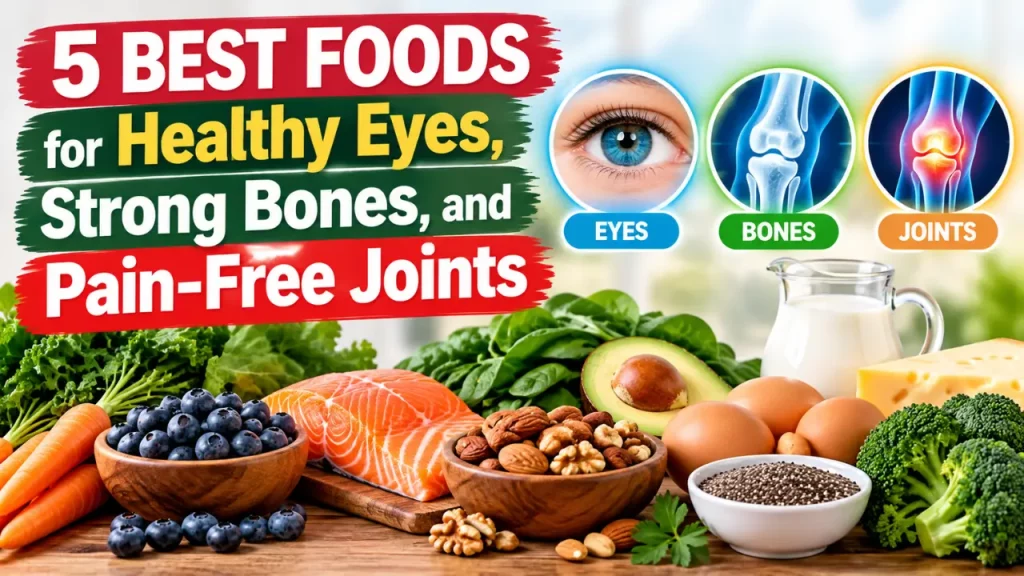
That distinction is the whole point here. Leafy greens for lutein and zeaxanthin, fatty fish for omega-3s and vitamin D, dairy and fortified foods for calcium, nuts and seeds for plant-based fats — you’ve heard all of that. What nobody tells you is the dose, the test to ask for, and who these foods won’t actually help once damage has started.
The dose that actually moved the needle on knee pain
Not every vitamin D trial failed. A pooled analysis of four randomized trials covering 1,136 patients found that a daily dose above 2000 IU significantly reduced WOMAC pain and function scores — but still had no effect on cartilage volume. Lower, more “food-like” doses didn’t do much at all. An earlier Boston trial gave patients 2000 IU a day, escalating the dose until blood levels passed 36 ng/mL, and still saw no slowing of cartilage loss. A separate three-year study using just 800 IU a day — closer to what a typical multivitamin or a few servings of fatty fish provides — also found no change in joint space narrowing, even though blood vitamin D rose from an average of 20.7 to 30.4 µg/L.
Put those three numbers side by side and a pattern appears: 800 IU does almost nothing measurable, 2000 IU alone doesn’t fix structure either, but somewhere above 2000 IU a day, pain and function scores start to improve even without rebuilding cartilage. That’s an important nuance — food and supplements at this level are treating the symptom, not reversing the disease.
Check this blood test before you supplement anything
None of these trials enrolled people blindly. Most required a baseline 25-hydroxyvitamin D level, and the Australian trial specifically recruited people whose levels sat between 12.5 and 60 nmol/L — deficient or insufficient by most lab standards. If you don’t know your number, supplementing is a guess. Ask your doctor for a 25-hydroxyvitamin D blood test before adding high-dose D3, since going from an already-adequate level to a very high one adds no proven benefit based on this evidence, and vitamin D is fat-soluble, meaning excess doesn’t simply wash out like a B vitamin would.
Omega-3s: what the joint-pain data actually shows
The largest test of this question came from the VITAL trial, which randomized 25,871 adults to vitamin D, marine omega-3s, or both. Researchers isolated a subgroup of 1,398 older adults who already had chronic knee pain, with an average baseline WOMAC pain score of 37 out of 100. That’s a meaningful starting point — this wasn’t a healthy-volunteer study, it was people who already hurt. The honest answer is that results across vitamin D and omega-3 trials for joint pain have been inconsistent: some show modest pain relief, others show none, and none of the trials here found omega-3s or vitamin D rebuilding cartilage itself. If you have existing joint damage, treat fish oil as a possible aid for inflammation and stiffness, not a repair tool.
The vitamin nobody explains: K2 versus K1
Spinach and kale give you vitamin K1, which supports blood clotting but barely touches bone metabolism in the way K2 does. K2 is made by bacteria, which is why it shows up in fermented and animal foods instead of greens: natto (fermented soybeans) carries the most by far, followed by aged hard cheeses, and then egg yolks and some organ meats in smaller amounts. This is the gap that trips people up — someone eating salads all day assuming they’re covering “vitamin K” for their bones is still missing the K2 form almost entirely.
This is also where a real warning belongs. If you take warfarin or another vitamin K–dependent blood thinner, suddenly increasing K1 or K2 intake — through greens or through K2 foods or supplements — can work directly against your medication and destabilize your clotting numbers. Don’t make dietary changes here without telling the doctor managing your anticoagulation.
If you’re rebuilding bone density, here’s the actual order of priority
Based on what’s been tested rigorously, vitamin D comes first — not because it rebuilds bone by itself, but because every calcium pathway depends on adequate blood levels, and the trials above show measurable symptom effects once intake passes roughly 2000 IU a day under medical guidance. Calcium comes second, since it’s the raw material bone is made from but does nothing without vitamin D to usher it into the body. K2 comes third: its role in directing calcium into bone rather than arteries is biologically plausible and worth getting from food, but it has far less large-trial evidence behind it than vitamin D does for pain and function. Be honest with yourself about this order instead of assuming all three matter equally.
Who these foods won’t help
Post-menopausal women losing bone density rapidly often need more than diet or standard-dose supplements can realistically supply, which is why bone density scans and physician-guided dosing matter more than food choices alone at that stage. People with existing kidney disease should not self-prescribe high-dose calcium or vitamin D, since impaired kidneys struggle to regulate both and the safety margin narrows. And if arthritis pain is your main issue, the clearest dietary habit to drop isn’t a mystery superfood you’re missing — it’s heavy, repeated intake of fried foods, refined sugar, and omega-6-heavy vegetable oils, which push the same inflammatory pathways these fish-oil and vitamin D trials are trying to calm.
The one clear takeaway: food helps prevention far more reliably than it reverses existing damage. If you already have joint pain, thinning bones, or vision changes, get the blood test first, use the doses shown to matter in trials, and treat greens, fish, and dairy as support for a plan — not the plan itself.
Sources
- Effect of Vitamin D Supplementation on Tibial Cartilage Volume and Knee Pain (JAMA, 2016)
- Effect of vitamin D supplementation on progression of knee pain and cartilage volume loss (JAMA, 2013)
- The Effects of Vitamin D and Marine Omega-3 Fatty Acid Supplementation on Chronic Knee Pain (Arthritis & Rheumatology, 2020)
- The effect of vitamin D supplementation on knee osteoarthritis: A meta-analysis (International Journal of Surgery, 2017)
- The effect of vitamin D supplementation on knee osteoarthritis, the VIDEO study (Osteoarthritis and Cartilage, 2016)

Mick Hudson
Low-and-slow recipes, rubs, sauces and fire management from our pitmaster team.