20 Foods to Eat and Avoid on an Empty Stomach: Fact vs. Myth
The avoid-list, the banana-magnesium number, and who should actually ignore empty-stomach advice: diabetics, GERD users, and more.
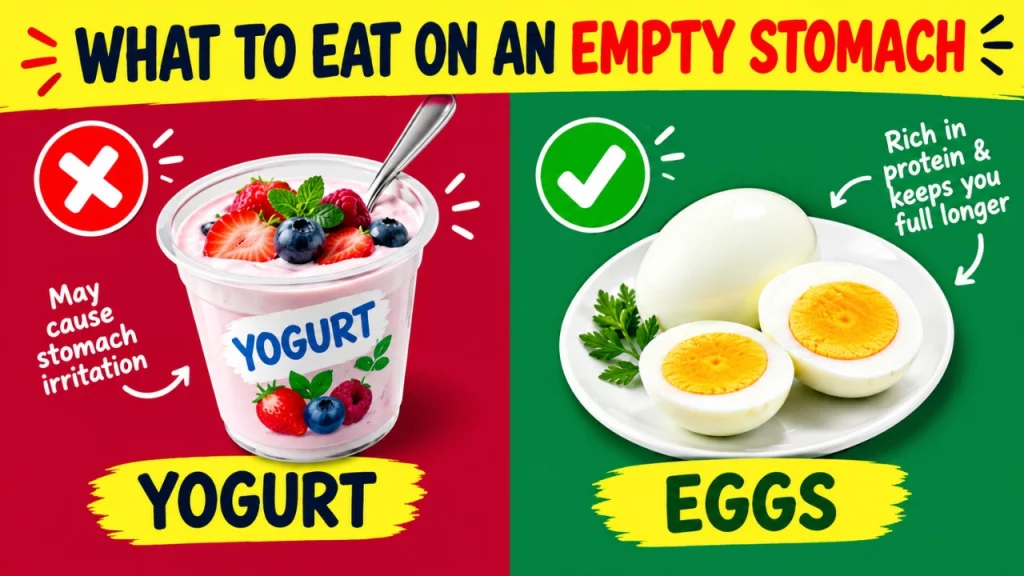
No food is dangerous on an empty stomach for every stomach — but for five specific groups of people, the generic advice is actually backwards.
Oats, eggs, yogurt, banana, melon, berries, almonds, whole-grain toast, cooked vegetables and water make up the gentle-starter half of this list, and that part isn’t controversial — most people tolerate all ten before anything else touches their stomach. What usually gets left unfinished is the other ten: the foods people are told to avoid first thing in the morning, and whether the fear behind them is backed by anything measurable. Here is that second half, finished, along with the numbers behind the two biggest myths and a guide to who should throw the generic rulebook out entirely.
Side One: The “Avoid” List, Finished — and How Much of It Is Fear vs. Fact
Coffee, citrus, spicy dishes, fried food, alcohol and sugary pastries already top most reflux-trigger lists, so they’re not repeated in detail here. The ten foods and drinks that round out a genuine empty-stomach avoid-list are these:
- Carbonated or sparkling drinks — the gas expands in an empty stomach and can trigger bloating and belching within minutes.
- Raw garlic and raw onion — high in sulfur compounds and fermentable fibers that some people feel as burning or gas on an empty stomach, though tolerance is highly individual.
- Energy drinks — the caffeine-plus-sugar combination hits an unbuffered stomach harder than coffee alone.
- Whey protein shakes taken alone — concentrated protein isolate with no fat or fiber can move through quickly and cause cramping in sensitive guts.
- Raw cruciferous vegetables (broccoli, cabbage, Brussels sprouts) — their fiber is harder to break down without other food present.
- Vinegar-based dressings or apple-cider-vinegar shots — straight acid on an empty lining is simply more acid, with no food to buffer it.
- Sugar-alcohol-sweetened “diet” snacks (sorbitol, xylitol) — these ferment and pull water into the gut, a known laxative effect that’s worse without other food slowing transit.
- Sweet, fatty baked snacks like oatmeal-cookie-style mixes — USDA nutrient data for oatmeal cookie dry mix shows 67.3 g of carbohydrate and 19.2 g of fat per 100 g, plus 473 mg of sodium per 100 g — a dense sugar-fat-salt combination, not a breakfast.
- Raw chili peppers or very hot sauce — short-term, capsaicin can trigger a burning sensation and faster gut transit, but that’s a reflux-type feeling, not stomach damage (more on that below).
- High-fat “bulletproof” style coffee drinks — fat plus caffeine on an empty stomach slows emptying while still stimulating acid, a combination that disagrees with many people at once.
Notice what’s missing from that finished list: real evidence of lasting harm. Almost every item causes short-term discomfort for sensitive people, not injury — which is exactly where the two biggest viral myths fall apart.
The Banana-Magnesium Scare, By the Numbers
The claim circulating online is that eating a banana on an empty stomach floods the body with magnesium and disrupts heart rhythm. USDA nutrient data for raw bananas puts that to rest with actual numbers: 27 mg of magnesium per 100 g, or 7.65 mg per 1 oz (28 g) serving. For comparison, that same oatmeal cookie mix contains 48 mg of magnesium per 100 g — almost double the banana, gram for gram — and nobody warns against cookies for magnesium overload. A whole egg, meanwhile, carries just 12 mg per 100 g (USDA egg nutrient data). A banana’s magnesium content isn’t unusually high in any direction; it’s unremarkable. The “scare” doesn’t survive contact with the nutrition label.
Spicy Food and Ulcers: What Actually Causes Them
The second myth is older: spicy food “causes” ulcers. It doesn’t. Peptic ulcers are driven overwhelmingly by Helicobacter pylori infection and NSAID use, not chili. A study of dyspepsia patients found that those testing negative for H. pylori actually consumed more fast and spicy food than those testing positive (stool H. pylori dyspepsia study, 2017) — the opposite of what the myth predicts. In a study of patients who had their H. pylori eradicated, reported food intolerance dropped from 71% to 44% among peptic ulcer patients within a year (P < 0.0001), and tolerance specifically improved for coffee, orange juice, fried food, spicy food and fruit (H. pylori eradication and food tolerance study, 2003). In other words, it wasn’t the spice damaging the stomach — it was the infection making an already-irritated stomach react to everything, spice included. A Saudi cross-sectional study of peptic ulcer patients found coffee drinking (81.8%) and physical stress (77.3%) reported more often as precipitating factors than spice specifically, among a total ulcer prevalence of 21.9% in that sample (peptic ulcer risk factor study, Arar, 2017) — a small, self-reported study, but one that still doesn’t put chili at the top. And in elderly patients in Vietnam, H. pylori prevalence reached 55.6%, with infrequent tooth brushing carrying an enormous odds ratio of 18.14 (H. pylori risk factor study, Vietnam, 2024) — hygiene and bacterial exposure, not diet, drove the risk. Left untreated, ulcer disease remains the leading cause of gastroduodenal perforation, a surgical emergency (<a href="https://doi.org/10.4103/jwas.j