10 Vitamin D-Rich Foods to Help You Meet Your Daily Needs
Food alone rarely hits the vitamin D target — here's the real math, who it fails, and how to decide if you need a supplement.
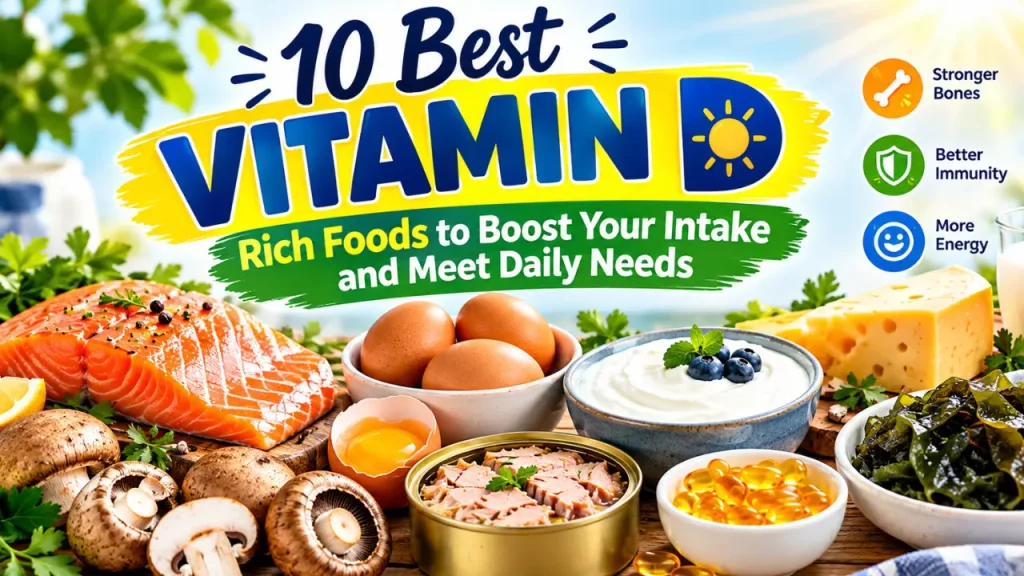
Could you actually eat your way to 600 IU of vitamin D today, without a sunny vacation or a supplement bottle in sight? Most lists answer that question by handing you a menu and letting you assume the arithmetic works out. It usually doesn’t, and nobody tells you that part.
For the record, the standard food list looks like this: fatty fish such as salmon, mackerel, sardines, and herring; cod liver oil, the most concentrated single source; UV-exposed mushrooms, the only meaningful plant source; egg yolks, a small but steady contributor; and fortified milk, yogurt, orange juice, and breakfast cereal, whose vitamin D content varies by brand. That’s your ten. The real question is what happens when you try to stack them into an actual day’s eating — and for whom the stack still comes up short.
The Food-Only Plate
Picture a realistic day: fortified cereal with milk at breakfast, two eggs, a yogurt snack, and a serving of salmon at dinner. That sounds like a vitamin D-conscious day by anyone’s standard. Yet observational data on actual eating patterns suggest this kind of effort lands people in the same range researchers found when they measured real diets rather than theoretical ones. In a prospective study of 1,194 mother-child pairs in Massachusetts, a study on maternal vitamin D intake and childhood wheeze found the average dietary vitamin D intake during pregnancy was 548 IU per day, with the lowest quartile at a median of just 356 IU per day and the highest quartile reaching 724 IU per day. That top quartile represents women eating unusually well for vitamin D — and even they were only brushing the low end of the 600–800 IU target, with most people landing closer to half that.
Two eggs a day illustrate the problem in miniature. Egg yolk is a real contributor, not a myth, but it is a rounding error next to a fish serving or a supplement capsule: it nudges the daily total up by a small margin, while a single serving of fatty fish or a basic supplement dose can supply several times more in one sitting. Treating eggs as a cornerstone of your vitamin D strategy, rather than a minor assist, is where a lot of food-first plans quietly fail.
Food sources fail even more completely for specific groups. People with darker skin pigmentation synthesize vitamin D less efficiently from sunlight, a risk factor documented clearly enough in newborns that a scoping review of maternal risk factors and infant vitamin D status lists it among the most consistent predictors of low vitamin D status across studies, alongside limited sun exposure. Older adults face a separate, compounding problem: a review of vitamin D deficiency in older patients found that this population frequently has both lower vitamin D status and more comorbidity and polypharmacy, and that drugs interfering with the CYP3A4 metabolic pathway or with intestinal absorption can blunt whatever vitamin D they do get from diet, according to a review on vitamin D deficiency, sarcopenia, and drug interactions in older patients. People with obesity store more vitamin D in fat tissue, making less available in circulation. And anyone with a malabsorption condition such as Crohn’s disease or celiac disease is working against damaged intestinal absorption before they even start counting IUs on a food label.
What does falling short actually feel like? Relying on food alone and still missing the target shows up less as a dramatic event than a slow drag: persistent fatigue, vague bone or muscle aches, and in the older-adult population specifically, the muscle wasting and weakness known as sarcopenia, which the same review on older patients links directly to low vitamin D plasma concentration alongside osteoporosis and osteomalacia.
The Food-Plus-Supplement Plate
Once food plainly isn’t closing the gap, the decision shifts to supplement type and dose rather than which fish to buy. The two forms sold over the counter are D2 (ergocalciferol, typically plant- or fungal-derived) and D3 (cholecalciferol, the form your skin makes from sunlight and the form found in animal foods like fatty fish and egg yolk). D3 is generally considered more effective at raising and sustaining blood levels over time, which is why most over-the-counter supplements default to it; D2 remains relevant for people who want a non-animal source. For most adults who are simply falling short of 600–800 IU through diet, a standard daily supplement in that range is a reasonable starting point, with higher doses reserved for diagnosed deficiency and managed by a clinician rather than self-selected off a shelf.
The interaction question deserves more honesty than it usually gets. A systematic review of drug-vitamin D interactions screened 109 reports and found that, despite growing supplement use, the evidence base connecting specific medications to vitamin D status is thin: only two controlled trials and three case-level studies were rated as high quality, and there was insufficient evidence to determine whether antiepileptic drugs, antimicrobial agents, lipase inhibitors, or antiretroviral therapy meaningfully change vitamin D effectiveness or toxicity, according to a systematic review of drug-vitamin D interactions. That means confident claims about vitamin D interacting with specific drugs like methimazole or common statins outrun the actual research. What is better supported is the older-adult picture: corticosteroids and other drugs that alter CYP3A4 activity or intestinal absorption can plausibly interfere with vitamin D metabolism in people already on multiple medications, which is why the review on older patients recommends vitamin D status be checked rather than assumed in anyone on heavy polypharmacy.
| Food-Only Strategy | Food + Supplement Strategy | |
|---|---|---|
| Realistic daily IU achieved | roughly 356–724 IU/day based on real dietary intake data, often below target | 600–800+ IU/day reliably achievable with a standard supplement added to meals |
| Works for darker skin, older age, obesity, limited sun | Frequently insufficient, per documented risk factors | Closes the gap regardless of skin tone or sun access |
| Works for malabsorption (Crohn’s, celiac) | Unreliable even with high intake | May still require medical-grade dosing and monitoring |
| Medication interaction risk | Low, since food-level doses are small | Needs a clinician check in polypharmacy, especially older adults |
| Cost and effort | Groceries only, but requires daily discipline | One capsule, minimal effort |
Neither side wins outright. Food should remain the foundation, since fatty fish, fortified dairy, and egg yolks also deliver protein, omega-3s, and other nutrients a pill can’t replicate. But for anyone in a higher-risk group, or anyone who has actually tallied a real day’s meals and found it landing in the 350–550 IU range, a modest daily D3 supplement is not an overreaction. It’s the more reliable way to hit a target that the food list alone statistically struggles to reach.
Sources
- Vitamin D Deficiency in Older Patients: Problems of Sarcopenia, Drug Interactions, Management in Deficiency (2021)
- Drug-vitamin D interactions: a systematic review of the literature (2013)
- Maternal intake of vitamin D during pregnancy and risk of recurrent wheeze in children at 3 y of age (2007)
- Maternal risk factors and newborn infant vitamin D status: a scoping literature review (2019)

Tom Fletcher
The latest from the Australian and global BBQ scene — comps, cooks and culture.