10 Healthy School Lunch Ideas for Kids to Support Brain Health & Focus
The hard timeline on blood sugar crashes, which "brain food" claims have real kid evidence, and who the advice doesn't fit.
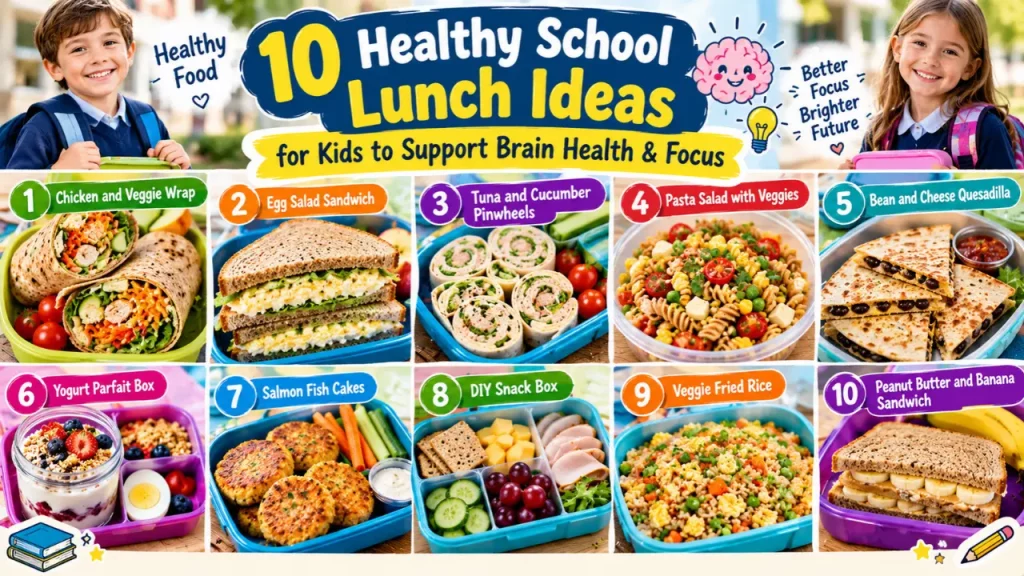
The most quoted fish-oil-for-brains trial on record followed children for twelve years and found nothing — no difference in cognition, language, or fine motor skills between kids whose mothers took fish oil in pregnancy and kids whose mothers didn’t. That single, inconvenient result is missing from almost every “omega-3 brain food” lunchbox list, and it changes how confidently anyone should talk about salmon sandwiches and attention spans.
The short version: a sugary lunch likely costs your child focus by mid-afternoon, but most of the specific “brain food” claims attached to lunchbox swaps come from pregnancy studies, not from feeding actual schoolkids tuna or eggs.
How quickly does a bad lunch actually wreck afternoon focus?
Faster than most parents assume, though the precise minute-by-minute timeline in children hasn’t been nailed down by classroom research the way parents might hope. What’s well established in general metabolic science is the shape of the problem: a lunch heavy in refined carbs and low in protein or fiber pushes blood glucose up quickly, and the body’s insulin response then tends to overcorrect, pulling glucose down below where it started. For a child, that dip typically lands in the window between the end of lunch and the last couple of classes of the day — exactly when teachers report kids getting fidgety, foggy, or irritable. The honest caveat worth telling parents directly: there isn’t a rigorous, time-stamped pediatric study pinpointing “focus drops at exactly 90 minutes.” What exists is physiology, not a stopwatch. That gap in the research is itself useful to know, because it means no one can responsibly give you a precise countdown — be skeptical of anyone who does.
Does choline in eggs really sharpen a school-age child’s attention?
The evidence for choline is real but it’s about babies in the womb, not sandwiches at noon. In a small controlled study, pregnant women who consumed 930 mg of choline a day in the third trimester — nearly double the 480 mg given to a comparison group — had children who performed better on a computer-based memory task at age 7, recalling dot locations more accurately after short delays. A related cohort study of over 1,200 mother-child pairs found that higher maternal folate intake in the first trimester was linked to vocabulary scores 1.6 points higher (95% CI 0.1–3.1) per 600 µg/day increase in folate — again, a prenatal measurement, not a lunchbox one. Nothing in this evidence tested whether eating egg salad at age 8 changes that afternoon’s attention span. Egg salad in a lunchbox is a fine protein source, but calling it a “brain food” for a 9-year-old is a marketing leap built on data about a different life stage entirely.
Do omega-3s from tuna or salmon measurably boost a child’s test scores?
The best long-term human evidence says no, at least not at the doses and timing tested. A randomized trial that gave pregnant women fish oil supplements followed their children for 12 years and found no significant differences in cognition, language, or fine motor skills compared with children of mothers who took placebo capsules. That’s a rare long-follow-up human trial, and it came back flat. It doesn’t prove omega-3s are useless for children’s brains generally — fish is still a reasonable lean protein choice — but it does mean the specific claim “pack tuna for brain power” is not backed by solid child-attention data the way lunchbox lists imply. Treat tuna or salmon as a good lean protein, not a proven cognitive enhancer.
How much protein or fiber does a lunch actually need to matter?
This is the honest gap: there is no well-established per-weight or per-age threshold from controlled research telling parents “give a 7-year-old exactly this many grams of protein to prevent a 2pm slump.” General pediatric nutrition guidance exists for daily totals, but nobody has run the controlled trial isolating a single school lunch’s protein or fiber content against afternoon test performance in children. What’s reasonable, absent that evidence, is pairing a protein source with fiber from whole grains or fruit at every lunch, since protein and fiber both slow glucose absorption compared with refined carbs alone — a mechanism, not a guaranteed number. If a list promises a precise gram count “for your child’s age,” there’s no study behind that precision yet.
Does a cold lunchbox sandwich lose nutrients compared with a hot meal?
Not meaningfully for most packed-lunch staples, and nutrient loss isn’t the real risk — food safety is. Refrigeration and time, not the cold itself, are what matter: proteins like egg salad, deli meat, or yogurt need an ice pack to stay below the temperature where bacteria multiply quickly, especially by the time a lunch sits in a backpack for four or five hours before being eaten. Vitamin content in packed fruits and vegetables does fade gradually with time and light exposure regardless of temperature, but the difference between a cold lunch eaten by noon and a hot one is small next to the bigger, well-documented problem: a lunch that’s gone unsafe to eat provides no nutrition at all because it won’t get eaten, or worse, it causes illness.
Who doesn’t this standard “balanced lunch” advice actually work for?
Plenty of kids, and generic lists rarely say so. Children with ADHD often do better with smaller, more frequent feedings rather than one large balanced lunch, since appetite suppression from stimulant medication can make a big midday meal unrealistic — a protein-forward snack before or after the dosing window may matter more than lunch composition itself. Kids with sensory sensitivities may reject entire food categories (textures of fish, mixed dishes like pasta salad) regardless of nutrient content, making the “just add salmon” advice pointless in practice. And children with food allergies are frequently left solving the protein-and-choline puzzle without eggs, dairy, or nuts at all — seed butters and legumes can fill some of that gap, but no study in the evidence above tested those substitutes directly for attention outcomes, so it remains a reasonable, not proven, swap.
So what should actually go in the lunchbox?
Given the honest state of the evidence, the safest bet is a lunch built on protein plus fiber plus minimal refined sugar — not because a specific study proved it raises a specific test score, but because it’s the one approach that avoids the glucose spike-and-crash pattern while not overpromising on “brain food” claims that mostly come from pregnancy research. Rotate protein sources (egg, bean, seed butter, lean meat) more for variety and allergy safety than for any single nutrient’s proven cognitive punch, and treat omega-3s and choline-rich foods as generally healthy additions rather than guaranteed focus boosters for a child already past infancy.
What’s your experience — have you actually noticed your child’s focus dip at a predictable time after lunch, or does it seem to depend more on what they ate that morning?
Sources
- Prenatal Choline Supplementation Improves Child Color-location Memory Task Performance at 7 Y of Age (2019)
- Maternal intake of methyl-donor nutrients and child cognition at 3 years of age (2012)
- Maternal fish oil supplementation in pregnancy: a 12 year follow-up of a randomised controlled trial (2015)